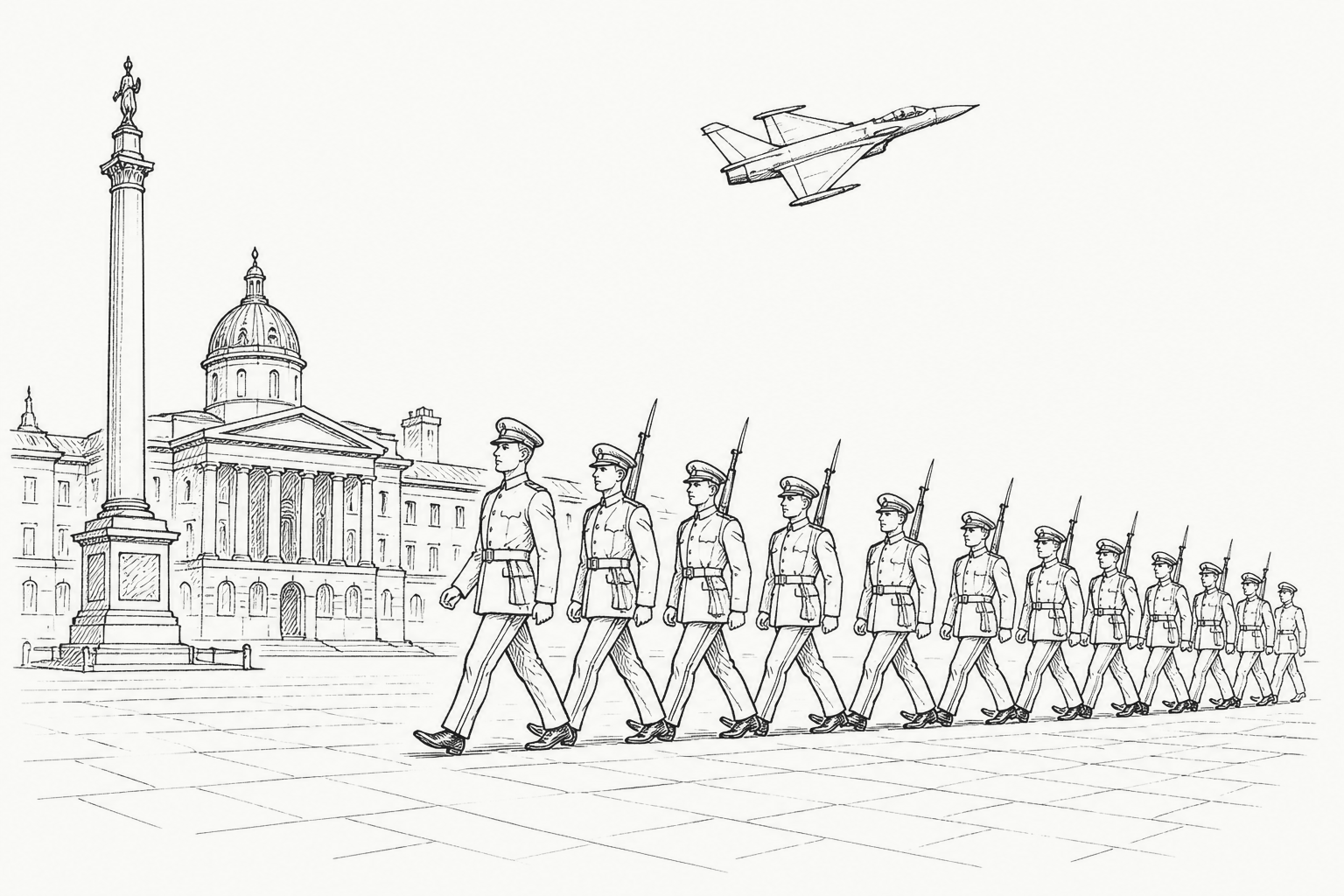
Russian President Vladimir Putin told reporters Saturday that the war in Ukraine is nearing its end as a three-day U.S.-brokered ceasefire took effect and Moscow staged a Victory Day parade stripped of the tanks and missiles that have rolled through Red Square every year since 2008. "I think it (the conflict) is heading to an end but it's still a serious matter," Putin said, according to Agence France-Presse, after a ceremony that traded armored columns for marching infantry and a single flyover of combat jets.
The pause, announced Friday by President Trump, runs from Saturday through Monday and includes the exchange of 1,000 prisoners by each country. It supersedes the dueling, unobserved truces declared earlier in the week, when Putin's unilateral 72-hour pause and Volodymyr Zelenskyy's counter-offer of a 30-day halt both collapsed amid fresh accusations of attacks from each side.
What was on the square
For the first time, North Korean troops marched in the parade, a public acknowledgment of Pyongyang's deployment of soldiers alongside Russian forces in the Kursk region. Russian officials attributed the absence of heavy weaponry to "the current operational situation" and the threat of Ukrainian drone strikes; state television commentators said the equipment was more useful at the front. Authorities cut mobile internet and text messaging across the capital for the day.
Foreign attendance was thin by the standards of past anniversaries. Belarusian leader Alexander Lukashenko, Kazakhstan's President Kassym-Jomart Tokayev, Malaysia's King Sultan Ibrahim Iskandar and the presidents of Laos and Uzbekistan stood with Putin on the reviewing stand. Slovakia's Prime Minister Robert Fico, the only sitting EU head of government in Moscow, laid flowers at the Tomb of the Unknown Soldier but skipped the parade itself. German Chancellor Friedrich Merz said of the trip, "I deeply regret this, and we will discuss his visit to Moscow with him."
What Putin offered Zelenskyy
Putin said he was willing to meet Zelenskyy in a third country, but only after the terms of a settlement had been agreed. "This should be the final point, not the negotiations themselves," he said. The Kremlin's framing rules out the kind of leaders' meeting Western mediators have pushed as a way to test whether a deal is possible at all.
Zelenskyy, who issued a presidential decree mockingly granting Russia permission to hold its parade unimpeded, prioritized the prisoner swap, saying the return of captured soldiers mattered more than the optics. Kremlin spokesman Dmitry Peskov called the Ukrainian decree a "silly joke."
The counterpoint
Secretary of State Marco Rubio, asked earlier about the state of U.S. mediation, said the talks had "stagnated" and had not produced "fruitful" results, NPR reported, a more guarded read than the president's. Russian state television's gloss on the missing parade hardware, that the equipment is needed on the battlefield, points the same way: a 72-hour pause and a prisoner trade do not, on their own, change a fifth-year war in which Russia's larger force is grinding forward along a front of more than 1,000 kilometers.
The ceasefire is scheduled to expire at the end of Monday.