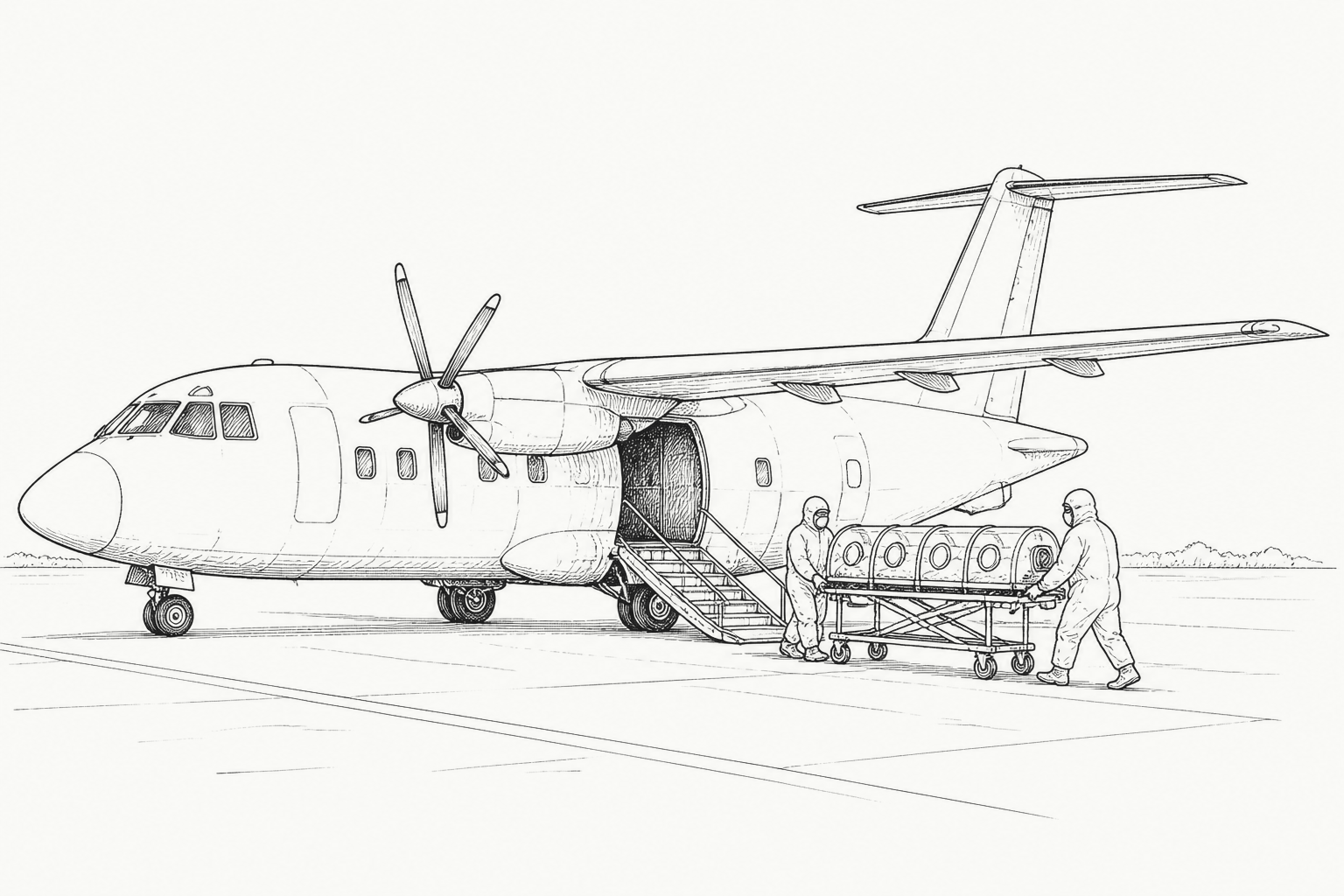
Seventeen American cruise passengers landed at Offutt Air Force Base outside Omaha early Monday aboard a U.S. government repatriation flight from Tenerife, and one of them had tested "mildly PCR positive for the Andes virus" while in the air, the Department of Health and Human Services said. A second American on the plane began showing mild symptoms during the flight. Both traveled in the plane's biocontainment units "out of an abundance of caution," HHS said.
The arrival opens the U.S. chapter of the MV Hondius hantavirus outbreak, which the World Health Organization has now linked to at least eight cases and three deaths since the Dutch-flagged expedition ship left southern Argentina on April 1. Sunday's edition reported the cruise had docked in Tenerife and that the Centers for Disease Control and Prevention was calling the domestic risk extremely low; Monday's landing is the first positive U.S. test tied to the outbreak.
On the ground
Most of the Americans were to be driven by motorcade from Offutt to the National Quarantine Unit at the University of Nebraska Medical Center for clinical assessment. The passenger who tested positive was headed instead to the adjacent Nebraska Biocontainment Unit, the hospital said, with follow-up testing to be performed. The federally funded quarantine facility, the country's only one, last received cruise passengers when the Diamond Princess docked U.S. evacuees in early 2020 at the start of the COVID-19 pandemic.
Dr. Ali Khan, dean of the University of Nebraska Medical Center's College of Public Health, said the Hondius travelers were arriving at "the premier facility in the United States, if not the world, to take care of you." Citing three decades of hantavirus research, Khan said "this is unlikely to become a pandemic."
The 17 Americans, plus a British citizen on the same plane, were among roughly 150 passengers and crew from 23 countries aboard the ship. Seven other Americans who left the cruise earlier are being monitored in Texas, California, Georgia, Virginia and other states, the CDC said.
What officials are saying
Acting CDC Director Jay Bhattacharya told CNN over the weekend that returnees would first be assessed in Nebraska and then given the choice of staying or going home for state and local monitoring. WHO Director-General Tedros Adhanom Ghebreyesus on Sunday repeated the agency's public posture: "This is not another COVID. And the risk to the public is low."
The Andes strain identified on the Hondius is the only hantavirus known to transmit between people, and only through prolonged close contact, according to the CDC. The rodents that carry it are not found in the United States. Symptoms can take up to 42 days to appear after exposure.
The counterparty
Public health experts have been less measured. Lawrence Gostin, a Georgetown University global health law professor, told NPR that the federal response has been "fragmented, disjointed, and delayed for weeks." Gostin said "The CDC was missing in action for quite a long time," and called the late mobilization "Better late than never — but it is very late." HHS spokesperson Emily Hilliard rejected the criticism, telling NPR that "These claims are completely inaccurate" and pointing to the agency's emergency operations center, deployments to the Canary Islands and Nebraska, and notifications to state health departments. Gostin acknowledged the federal response has accelerated in recent days while arguing the episode exposed gaps in U.S. pandemic preparedness.
Markets read the arrival as a sentiment event rather than a commercial one. Moderna rose 7 percent in premarket trading Monday after disclosing earlier preclinical hantavirus work with the U.S. Army Medical Research Institute of Infectious Diseases. Evercore ISI had told clients last week that "Hantavirus is a low-incidence, structurally small market" and that any move was "sentiment-driven, not fundamental."
The 42-day monitoring window for the Omaha arrivals runs into late June.