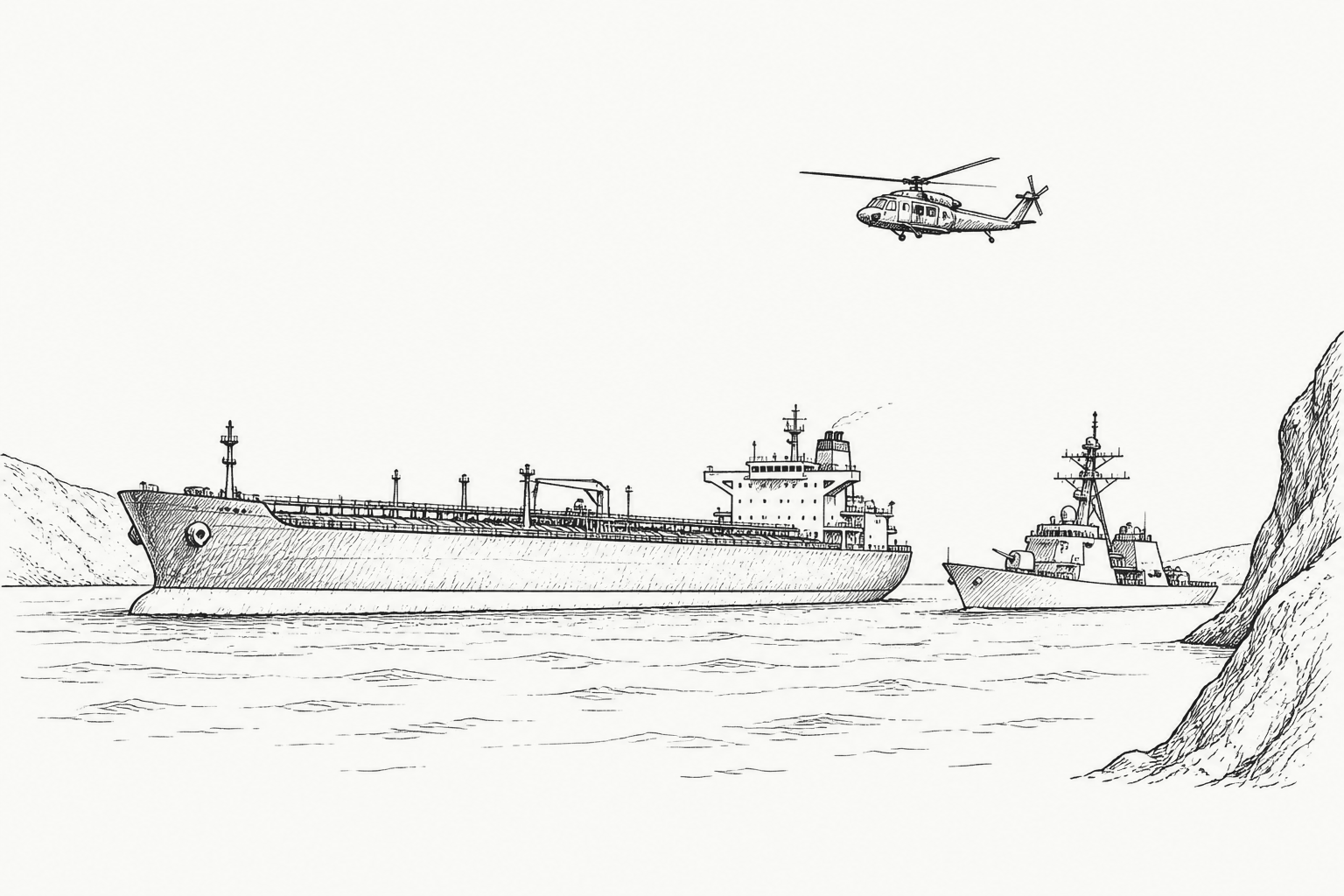
Retired U.S. flag officers are publicly splitting over whether Washington should resume military operations against Iran, with retired Vice Adm. Mark Fox calling a return to combat operations all but unavoidable and retired Lt. Col. Daniel Davis warning that more strikes would be "irrational," as the Strait of Hormuz standoff enters its third month and keeps Brent crude anchored above $100 a barrel.
The debate carries direct policy stakes. President Trump on Monday told reporters the ceasefire with Iran is "on massive life support" and dismissed Tehran's latest counterproposal as "a piece of garbage," Fox News reported, with the White House said to be reviewing military options should negotiations collapse. The choice between resuming strikes and holding the ceasefire now sits at the center of a supply shock that has already reached into the U.S. inflation data.
The hawkish case
Fox, the former deputy commander of U.S. Central Command, told Fox News Digital he sees no diplomatic exit. "I really cannot envision anything other than a full return to combat operations," Fox said. "The only thing that they will respond to, I think ultimately, is force."
Fox argued the U.S. Navy could reopen and secure commercial shipping through the strait with guided missile destroyers, attack helicopters, drones and expanded aerial surveillance. "This is a militarily obtainable objective," he said. He conceded the Navy is smaller than during the 1980s tanker wars but said the chokepoint can still be held. "It's not easy," Fox said. "But the geography is fixed."
Fox signed onto a recent policy paper by the Jewish Institute for National Security of America, co-authored by retired Gen. Chuck Wald and retired Vice Adm. Robert Harward, that argued the current diplomatic track "cannot reliably compel Iran" and that Tehran was seeking to "drag out talks, erode U.S. resolve, and use the time to strengthen itself." The paper called for expanded operations against Iranian maritime capabilities, missile infrastructure and internal coercive apparatus while avoiding strikes on civilian infrastructure.
Retired Lt. Gen. H.R. McMaster, Trump's former national security adviser, offered a parallel read on the diplomatic ceiling. "I think the Iranian leadership and IRGC are unwilling to make the kind of concessions that President Trump thinks are at the minimum," McMaster told Fox News Digital. "President Trump always wants a deal," he added. "But he's not going to sign up for a bad deal."
The dissent
Davis, a senior fellow at Defense Priorities, said the recent fighting already exposed the limits of force. "To 'finish the job,' as they say, is irrational," Davis told Fox News Digital. "It's illogical, and it violates any kind of military principle."
Davis said Iran retained significant missile and maritime capability despite weeks of fighting. "We couldn't knock them out with 14,000 targets hit," he said. "Why does anybody think that going back another time is going to have a different result?" He described Iran's dispersed missile infrastructure and asymmetric naval tactics as "a militarily unsolvable problem," concluding that "The only thing left is a diplomatic outcome."
Into the price data
The supply pressure is already in the numbers. The April consumer price index ran at a 3.8 percent annual rate, the hottest in nearly three years, the Bureau of Labor Statistics reported Tuesday, per CNBC. Food at home posted its largest one-month jump since August 2022, with uncooked ground beef up 14.5 percent from a year earlier amid soaring cattle prices — one downstream data point in a story that runs from the strait to the supermarket.
The White House had not publicly responded to the retired commanders' policy paper by press time.
Trump meets Chinese President Xi Jinping in Beijing on Thursday, with the Iran war atop the agenda.