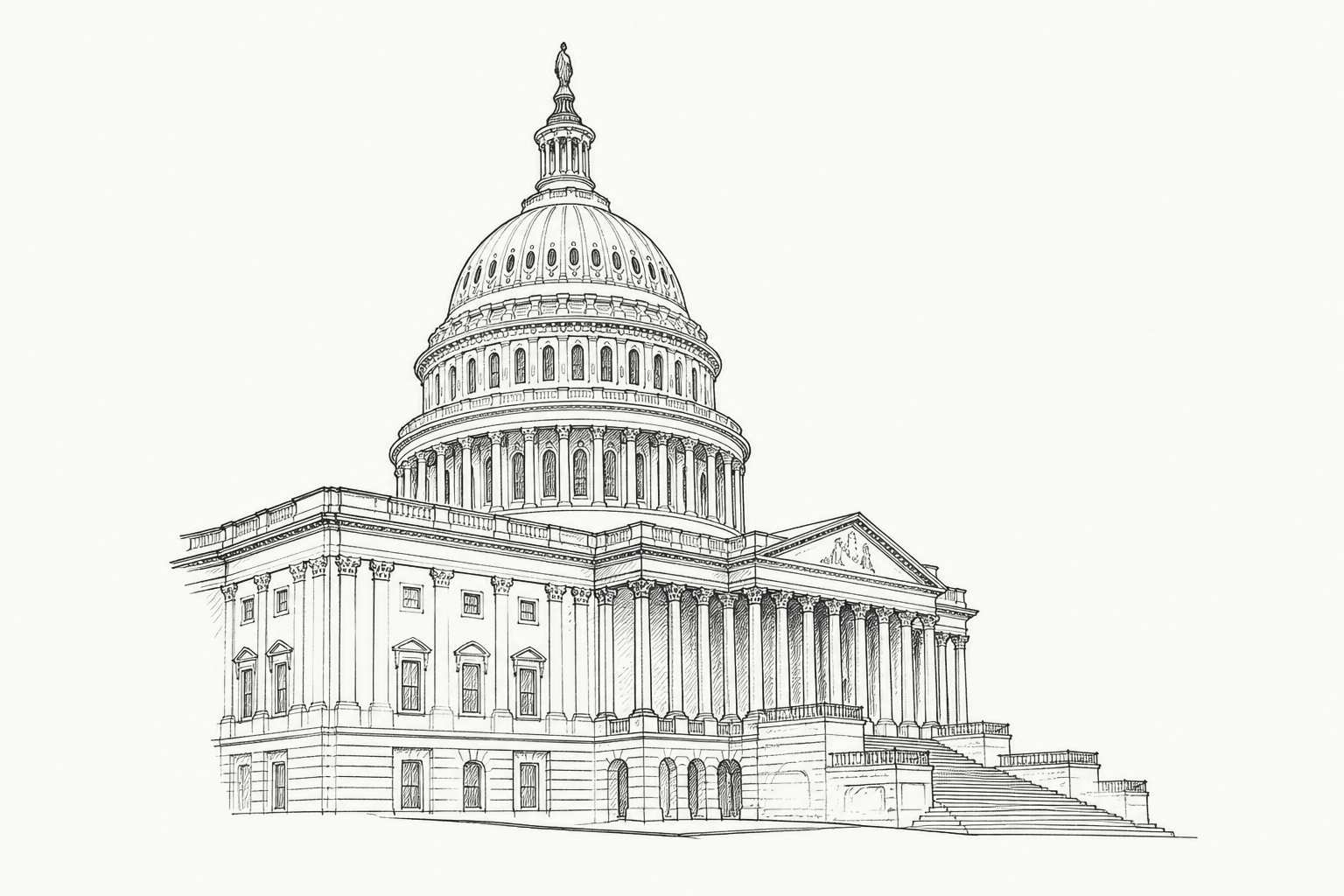

WASHINGTON — The House on Wednesday passed a war powers resolution ordering President Trump to halt military action against Iran, the first time the lower chamber has formally defied the White House over a war that has now run three months. The vote was 215 to 208, with four Republicans crossing over to give Democrats unanimity on a measure that had failed three previous times.
The rebuke arrives as Trump struggles to close a negotiated end to a conflict that has dragged past the 60-day window set by the War Powers Resolution of 1973 and as economic fallout begins to weigh on Republican midterm prospects. Senate leaders have not said when they will schedule a vote on the House version, leaving the resolution's practical force uncertain even as its political signal lands.
The defectors
Republican Reps. Thomas Massie of Kentucky, Brian Fitzpatrick of Pennsylvania, Tom Barrett of Michigan and Warren Davidson of Ohio voted with Democrats. Rep. Jared Golden of Maine, who had opposed each of the three earlier attempts, switched sides and gave his party a unified bloc for the first time. Cheers erupted in the chamber as the tally closed, according to PBS NewsHour.
The vote had been scheduled before the Memorial Day recess, but House GOP leaders pulled it from the floor when it became clear they lacked the numbers to block it. Speaker Mike Johnson, who shut down floor action two weeks ago as the measure neared approval, was unable to repeat the maneuver Wednesday. Several Republicans who had been absent for earlier attempts returned, and others who had hedged moved into the yes column.
What the measure says
The resolution, introduced in April by Rep. Gregory Meeks of New York, the top Democrat on the House Foreign Affairs Committee, directs the president "to remove United States Armed Forces from hostilities with Iran," unless Congress declares war or authorizes the use of military force. The 1973 statute on which it relies requires the president to withdraw forces from hostilities if Congress has not authorized them within 60 days.
The war passed that deadline on May 1. The Trump administration has argued that a fragile ceasefire reached in early April paused the clock, although both sides have carried out strikes since then, including the round of U.S.-Iran exchanges that hit Kuwait International Airport and Iran's Qeshm Island on Tuesday. The administration has also argued that the 1973 statute is itself unconstitutional, a position that has never been tested in court.
Why support cracked
Republican unease has tracked the war's calendar more closely than its battlefield. Some members have said privately they are uncomfortable with the absence of a congressional authorization and the lack of a clear off-ramp. Others are looking at November. Rep. Ashley Hinson of Iowa, who is running for Senate, said in a private exchange at a campaign stop last week that the war could become a "political liability" if it continued beyond "the next couple of weeks," according to audio obtained by CBS News.
Trump has signaled the opposite urgency. "Everybody's saying, 'Oh, the midterms, I'm in a hurry.' I'm in no hurry," the president said last month, repeating the "no hurry" line he has used since late May as draft U.S.-Iran terms have shuttled between Washington and Tehran.
Fitzpatrick, who also voted in favor of a war powers resolution in May, framed his vote as a matter of statutory compliance. "The law is the law," he said. "We have to follow the law. There's a law on the books," Fitzpatrick told reporters. "So you have two choices: You either follow the law or you change the law. You can't violate the law. That's not an option."
House Democratic Leader Hakeem Jeffries of New York pressed the measure earlier in the week. "This reckless and costly war of choice needs to end today," Jeffries said, in remarks carried by PBS NewsHour.
The counterpoint
Republican leaders argued the vote will hand Tehran leverage at the negotiating table. Rep. Brian Mast of Florida, the Republican chairman of the House Foreign Affairs Committee, called the measure a "stupid political vote" that "weakens the president's hands as he's negotiating with Iran." Rep. Kevin Kiley of California, an independent who caucuses with Republicans, said the resolution was the wrong instrument even for members who want to constrain the war. Congress, Kiley said, has "better tools" through its power of the purse — appropriations language directing how funds may be used — that "really have teeth here." An authorization for the use of military force introduced by Barrett earlier in May has not advanced.
What happens next
The Senate cleared a procedural hurdle on a similar measure in May, when four Republicans joined nearly all Democrats to push it forward after seven failed votes; three Republican absences helped. That was only the first step, and Republicans will have another chance to block the Senate version in the coming days. House Democratic leaders, in a statement issued after Wednesday's vote, called on Senate Republicans "to do the right thing." Meeks, asked whether Democrats would keep forcing the issue, said, "You can expect us to continue to do our jobs."