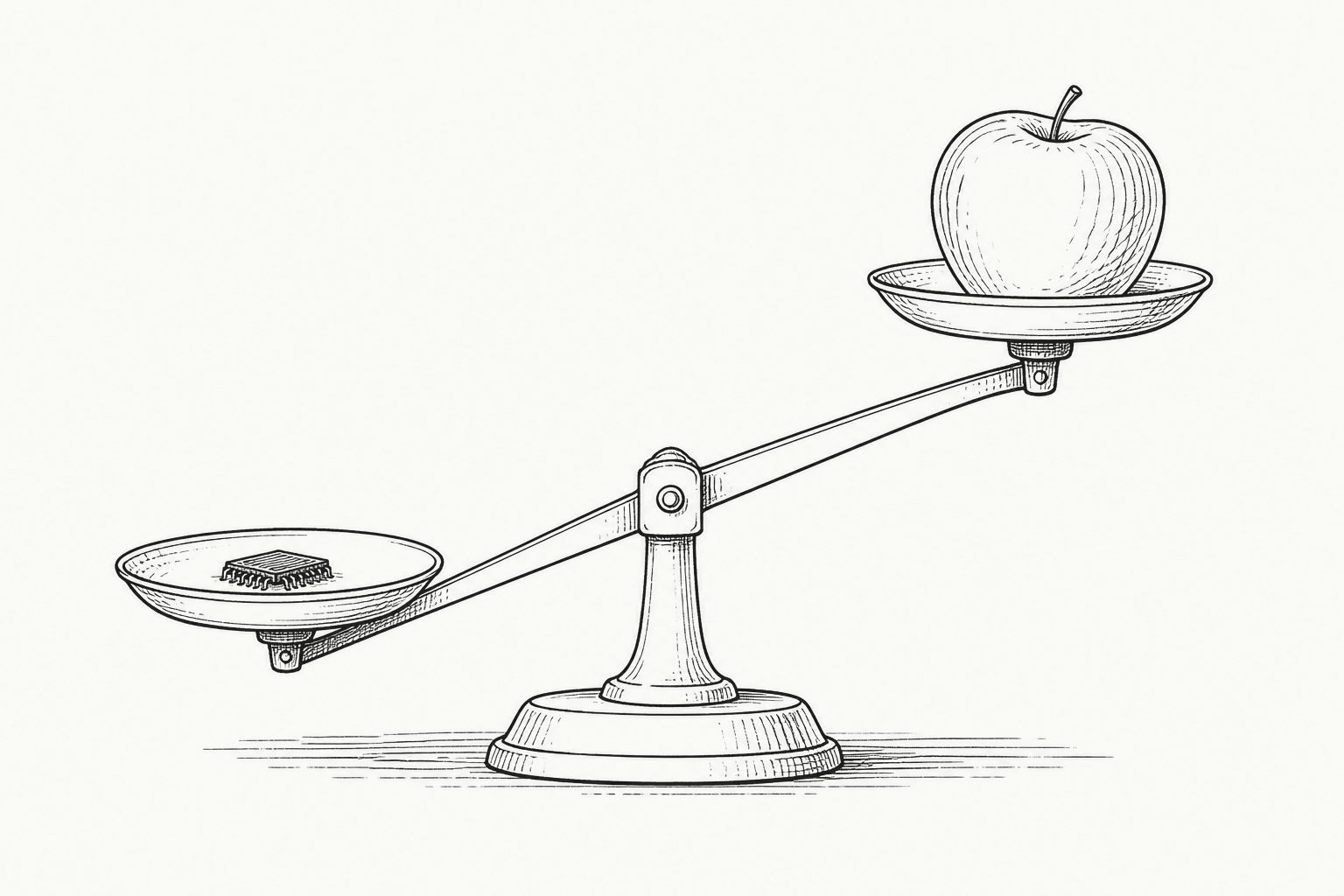

Apple briefly overtook Nvidia as the world's most valuable company Friday morning, ending the chipmaker's 13-month run at the top of the U.S. equity market as investors extended a rotation out of artificial-intelligence chip stocks and into companies further from the data-center capital-spending cycle.
Nvidia shares dropped about 3 percent in early trading, cutting the chipmaker's market value to about $4.84 trillion, CNBC reported. Apple, which has climbed 22 percent this year, hovered near $4.88 trillion, a lead of less than $40 billion. Nvidia had held the crown since June 2025, when it eclipsed Microsoft, and in October became the first company to reach a $5 trillion market capitalization.
What shifted
The gap between the two companies' 2026 performance is now the widest of the AI cycle. Apple hit fresh highs this week on what CNBC described as investor reward for the iPhone maker's "AI agenda and capital spending model." Nvidia has gained just 7 percent year to date as Wall Street pivots to the memory-chip and infrastructure phase of the data-center buildout, a rotation that has benefited Micron Technology and Sandisk.
The IBM shock
The reversal builds on Tuesday's cratering of International Business Machines, whose shares fell just over $73 to about $217 — a 25 percent single-session drop that CNBC called the steepest since Jan. 3, 1968. The catalyst was a preliminary second-quarter revenue miss of $17.2 billion, against a $17.9 billion consensus, driven by a 7 percent slide in the infrastructure division. Chief Executive Arvind Krishna told analysts that enterprise customers were hoarding cash to buy hardware, servers and storage ahead of expected AI-related price increases — a defense the market did not accept. IBM's one-month implied volatility remains in its 99.6th percentile, surpassed only by the 2020 pandemic plunge.
Priced for perfection
Options positioning heading into second-quarter earnings suggests investors expect the rotation to broaden. In a survey of the most actively traded S&P 500 names using Nations Indexes' proprietary RiskDex metric, Meta Platforms and Microsoft led on bullish call skew, followed by Amazon, Tesla and Advanced Micro Devices. Meta's out-of-the-money calls trade 25 percent above equivalent puts, a reading in the 91st percentile over the past year; Microsoft's ratio, at 0.79, sits in the 93rd.
"When you get this many names that have this much call skew, I think it's a contrary indicator," Scott Nations, president of Nations Indexes, said by phone. "The bullishness is so extended that they're priced for perfection." Nations pointed to Nvidia's own reaction to its most recent report, saying the chipmaker "gave great numbers and just kind of melted."
Netflix drags
Streaming added to the pain. Netflix shares fell roughly 10 percent in Friday's early trading after the company reported second-quarter revenue of $12.56 billion — up 13 percent year over year, but slightly below analyst estimates — and narrowed 2026 guidance to a $51 billion to $51.4 billion range, from $50.7 billion to $51.7 billion previously. The company said it still expects to double advertising revenue to $3 billion this year.
Co-Chief Executive Greg Peters cautioned analysts against reading too much into viewing hours. "I'll start by saying there is not a linear relationship between viewing hours and revenue and profit, because all hours are not created equal," Peters said. Netflix also disclosed that roughly 300 titles on the service used generative artificial intelligence in production, including 17 minutes of AI-enhanced footage in the docuseries The American Experiment.
The counterparty
The bullish rebuttal was absent from Friday's wire coverage. No sell-side analyst was quoted defending Nvidia's earnings power against the skew reading, and no long-only manager appeared on the tape arguing that the AI-chip drawdown is a healthy consolidation rather than a regime change. The AI-optimist case that carried markets through the first half of 2026 went unmade in reporting on the reversal. The rebuttal, if it comes, will need to arrive with earnings.
What comes next
Meta and Microsoft report second-quarter results in the last week of July. Nvidia's fiscal second-quarter earnings are expected in late August. TSMC — which supplies the most advanced chips for both Nvidia and Apple, and which reported a 77 percent jump in second-quarter net profit to $22 billion on Thursday alongside another $100 billion Arizona commitment — has said it does not rule out further price increases.