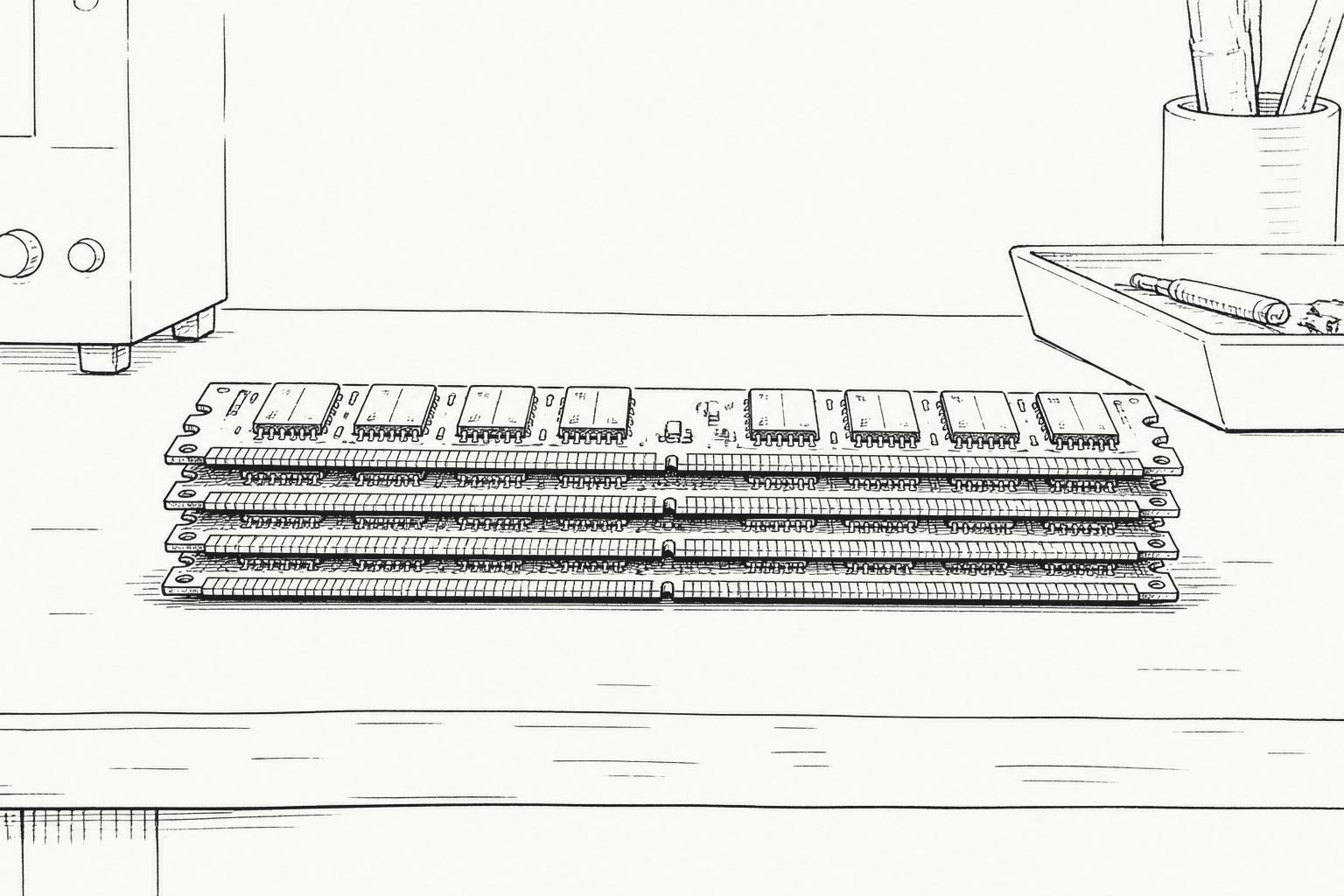
SK Hynix shares plunged 14.65 percent in Seoul on Tuesday, forcing a 20-minute halt on South Korea's Kospi and driving the benchmark to a 10.8 percent loss on the day, as a report that Nvidia is in talks to backstop roughly $250 billion for OpenAI's Ohio data-center project touched off a global selloff in artificial-intelligence stocks.
The rout marks the sharpest test yet of investor tolerance for the circular financing arrangements binding Nvidia to its largest customers, and reversed the tape from Friday, when Nvidia and SK Hynix unveiled a memory-supply pact that could be worth up to $500 billion. Nvidia fell 5 percent in New York on Monday, ceding its title as the world's most valuable listed company to Apple, whose shares have risen about 25 percent this year.
What triggered the slide
The Wall Street Journal reported Sunday that Nvidia is in discussions to provide roughly $250 billion in backing to OpenAI as the ChatGPT maker seeks to lease a proposed 10-gigawatt data center in southern Ohio, being built by SB Energy, a subsidiary of Japan's SoftBank. According to the Journal, Nvidia's balance sheet would allow OpenAI to raise debt on better terms than its own credit could command. The financing would be layered on top of a $30 billion Nvidia investment in OpenAI earlier this year, and the WSJ report also said Nvidia was in talks to finance OpenAI's chip purchases separately. Nvidia has also invested in Anthropic and multiple neocloud providers that rent its chips to customers.
The Asian sweep
Samsung Electronics fell more than 13 percent in Seoul, and Samsung SDI dropped 11.37 percent. Kospi trading was paused for 20 minutes under a circuit breaker before resuming and closing sharply lower. In Tokyo, memory chipmaker Kioxia plunged more than 18 percent, Tokyo Electron dropped 10.96 percent and Advantest slid more than 10 percent. Japan's Nikkei 225 closed almost 4 percent lower. Taiwan's TSMC closed nearly 3 percent lower, while Hong Kong's Hang Seng China Semiconductor Chips Index fell 7.02 percent. U.S.-listed SK Hynix shares fell 7.5 percent Monday to well below the $149 offer price set at its record-breaking Nasdaq debut on July 9.
Europe and premarket
Chip losses spread but broad indexes did not. ASML fell after The Information reported that a Chinese company is manufacturing an immersion deep-ultraviolet lithography machine, a market the Dutch equipment maker has long dominated; ASM International and BE Semiconductor slipped 2 to 3 percent in early trade. In U.S. premarket trading, Micron dropped nearly 5 percent, Intel and AMD each fell more than 3 percent, and Nvidia slipped a further 1.2 percent. Europe's broad-market indexes — the FTSE 100, CAC 40 and DAX 40 — traded about 0.6 percent higher, buffered by limited chip exposure.
What analysts said
Jane Sydenham, investment director at Rathbones, told the BBC that the Korean market is "very concentrated" in Samsung and SK Hynix, and that heavy use of debt by Korean retail investors "exaggerates the movements when we get a correction like this". Owen Lamont, senior vice president at Acadian Asset Management, told CNBC that "No one has any idea how this AI process is going to affect our economy, and so I think it's going to be rocky no matter what." Cheng Chye Hsern, head of investments at Providend, said Apple's outperformance this year reflected its status as one of the few large-cap tech firms "not taking part in the AI race".
The other view
Sundeep Gantori, chief investment officer for equities at Standard Chartered, argued the long-term outlook remains intact and said memory prices are likely to peak in 2027 but that "at current valuations, risk-reward has improved." Nvidia has said its investments are designed to support the AI ecosystem and represent worthwhile uses of cash. Nvidia and OpenAI had not commented on the WSJ report by press time, and no industry-critical voice was publicly on the record.
Meta, Microsoft and Amazon report earnings later this week, giving investors their first full quarterly readout on hyperscaler capital-spending plans since the Nvidia-OpenAI report surfaced.