BOGOTÁ — A magnitude 7.4 earthquake in western Colombia killed at least 132 people, injured more than 570 and left more than 2,700 reported missing after it struck the mountainous Chocó province on Monday morning, in the strongest quake to hit the country since record-keeping began in the early 1920s.
The disaster is the first major test of newly sworn-in President Abelardo de la Espriella, who took office Friday, and the second catastrophic earthquake in the northwestern corner of South America in six weeks. Authorities warned the death toll would climb as rescue crews reached the remote epicenter near San José del Palmar and dug through collapsed apartment blocks, hospitals and airport terminals in the cities of Pereira, Cali and Manizales.
What collapsed
Pereira, in Colombia's coffee-growing Risaralda region about 55 kilometers from the epicenter, absorbed the worst damage. Local authorities reported at least 67 people dead across the metropolitan area and 65 collapsed buildings, with people believed trapped in 15 of them, the BBC reported. Pereira Mayor Mauricio Salazar told a local radio station that many victims were pinned under "a massive quantity of collapsed buildings."
In Cali, a city of 2.2 million people about 200 kilometers south of the epicenter, at least 30 structures collapsed, Mayor Alejandro Eder said. Several of the top floors of one Cali hospital — some dedicated to pediatric care — collapsed on themselves, hospital director Irne Torres Castro told Caracol television, trapping patients and forcing about 600 others to be treated on rubble-strewn streets. Volunteers formed human chains to remove concrete by hand, Al Jazeera reported.
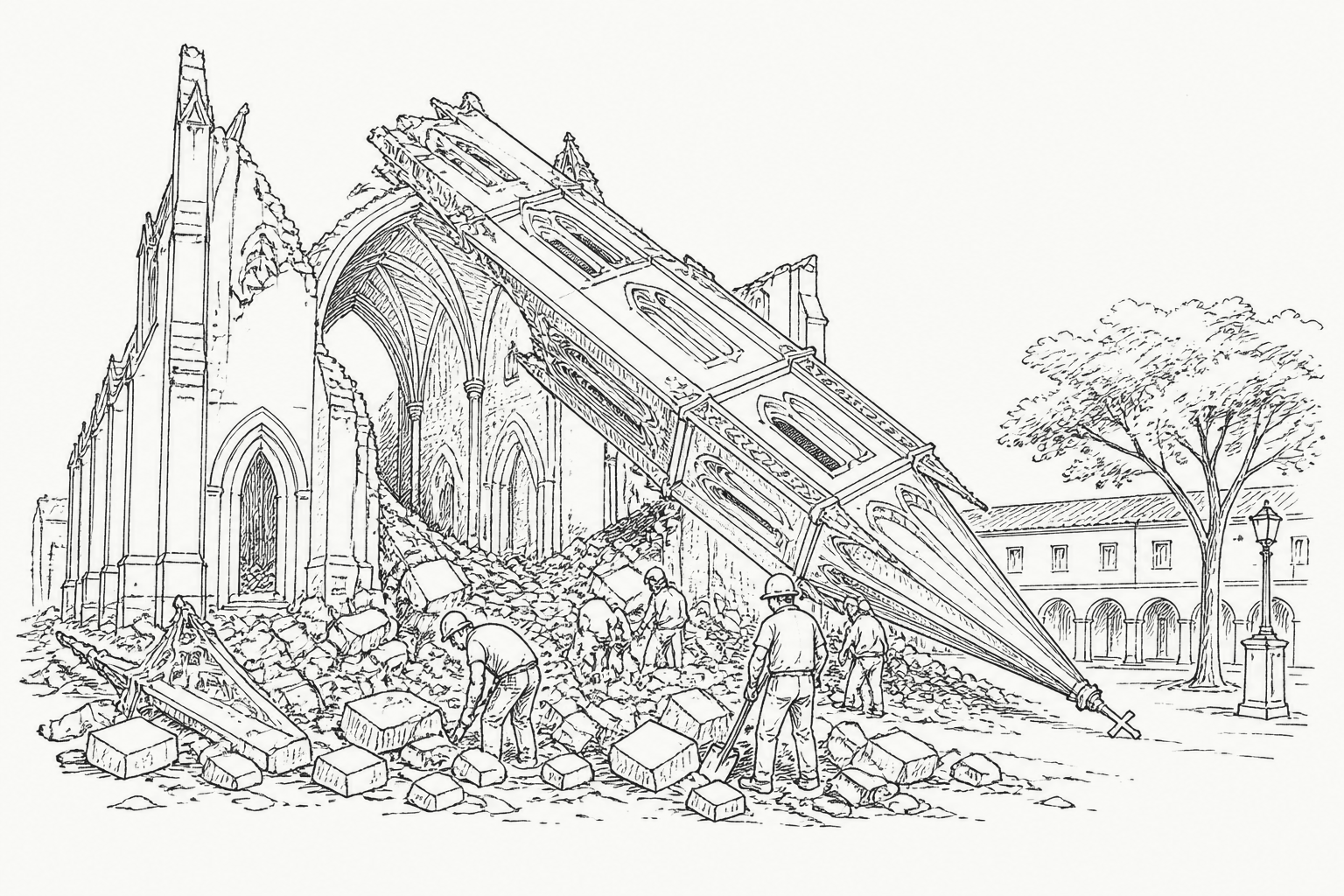
Damage stretched more than 400 kilometers from the source. In Manizales, Mayor Jorge Eduardo Rojas said 17 buildings had collapsed and 19 had partially collapsed, and one tower of the city's neo-Gothic cathedral fell onto the nave. Aviation authorities suspended flights at airports in Pereira, Manizales, Quibdó, Armenia, Cartago and Buenaventura for structural inspections. Tremors were felt in Ecuador, Panama and Venezuela.
The Chocó problem
The epicenter sat at an unusual depth of 103 kilometers, according to Colombia's geological service. San José del Palmar itself, a community of 4,800 people about 400 kilometers west of Bogotá, reported no confirmed deaths or injuries, local mayor León Fabio Marín Moncada told the BBC, though roads in and out were damaged. Much of Chocó is reachable only by boat or plane, Al Jazeera reported, and engineers, rescue workers and search dogs were still en route by Monday night, leaving the full extent of the destruction in the epicenter zone unclear.
Camila Gomez, deputy director of programs for Colombia and Venezuela at the International Rescue Committee, said, "This is the largest earthquake that Colombia has experienced in two decades." A 1999 quake in the same coffee region killed more than 1,200 people.
A presidency tested
De la Espriella, a conservative sworn in Friday in Cali, declared a national state of emergency, unlocked special budget powers to reallocate funds and said the government had mobilized the "entire military and police apparatus" for the response. About 1,000 members of the security forces would deploy to Cali by dawn Tuesday after reports of looting, he said, and Cali, Armenia and Manizales imposed overnight curfews.
"Our intention is to cooperate in any way necessary. Here, there are no distinctions or ideological divisions when it comes to defending our people or showing solidarity," de la Espriella told journalists, according to Al Jazeera. In a video message to citizens, the president said, "You are not alone."
Outside help
The United States announced $15.5 million in emergency assistance for shelters, food and other relief. Secretary of State Marco Rubio said Washington was "closely monitoring" the situation and "stands ready to support the people of Colombia." The European Union activated its Copernicus satellite service to help map the damage.
Salvadoran President Nayib Bukele and Mexican President Claudia Sheinbaum, whose governments led the international response after Venezuela's twin June earthquakes killed more than 5,000 people, said they were ready to send teams. Bukele said, "From El Salvador, we are in communication and ready to provide immediate support with our rescue teams, medical personnel, paramedics, supplies or any other assistance."
The unknown toll
Casualty figures diverged Monday night. CBS News reported 111 deaths and 87 injuries, citing Colombian authorities. The BBC and Al Jazeera later put the toll at 132 dead and more than 570 injured as local officials updated tallies through the day, and de la Espriella separately reported 700 injured in Valle del Cauca alone. The 2,700-plus missing figure came from citizen-run websites and did not represent confirmed cases. With much of Chocó reachable only by boat or plane and 21 aftershocks recorded by late Monday, Colombian officials cautioned that the true toll from the epicenter zone may not be established for days.
Colombia's Geological Service said further tremors were possible. Authorities postponed the Petronio Alvarez Music Festival in Cali, an annual celebration of Pacific music that was to open Wednesday, and suspended professional football matches. The overnight curfews in Cali, Armenia and Manizales were set to remain in force through Tuesday morning.