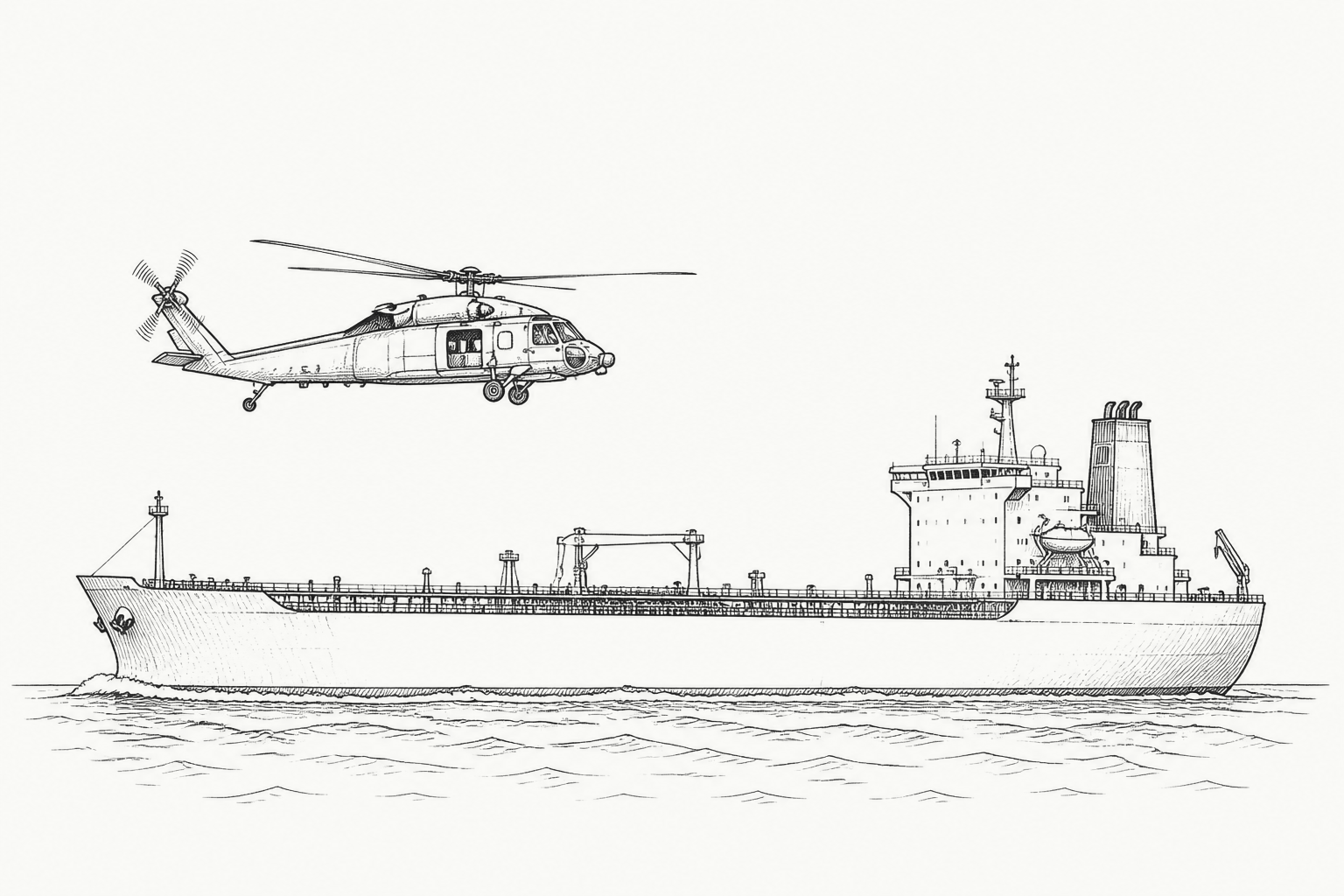
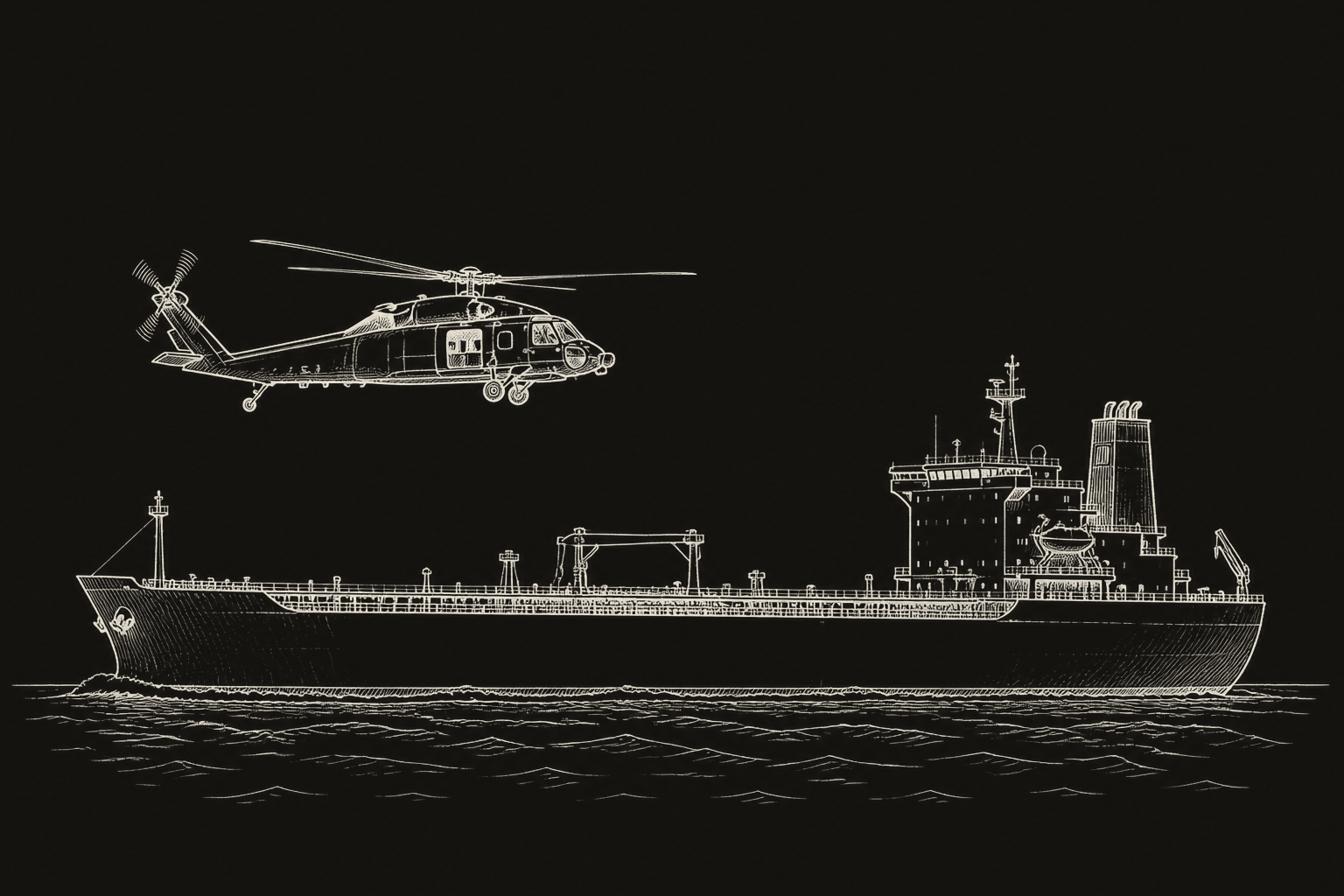
WASHINGTON — A U.S. Navy helicopter fired two Hellfire missiles into the engine room of a Panama-flagged cargo ship attempting to break the American blockade of Iranian ports Tuesday, U.S. Central Command said, hours before President Trump publicly confirmed for the first time that he switched to a decoy jet on a July flight home from Turkey after what officials described as an Iranian threat to Air Force One.
The disclosures on Tuesday underscored how far the confrontation has hardened since both sides last week signaled openness to talks. Six months after the U.S. and Israel began the war, Iran has kept the Strait of Hormuz closed, commercial traffic through the waterway has thinned to a fraction of prewar levels and the president has for the first time acknowledged that an Iranian threat has altered how he travels.
The strike
An MH-60 aircraft targeted the M/V Vela Nova in the Gulf of Oman after "the ship's civilian crew ignored repeated warnings from American forces," Central Command said. The strike disabled the vessel's steering, and Central Command said the ship "is no longer transiting to Iran." The command did not report casualties. It said the blockade "remains in full effect," and that as of Aug. 11 it had redirected 55 commercial vessels trying to run it, disabled three and boarded two.
Iran has been enforcing its own counter-closure of Hormuz. Mohsen Rezaie, the newly appointed head of Iran's Supreme National Security Council, told China's ambassador to Tehran, "As long as America does not change its behaviour and does not accept Iran’s conditions, the Strait of Hormuz will not be opened," the semi-official Tasnim news agency reported. Rezaie also demanded an end to the U.S. blockade of Iranian ports, sanctions relief, the release of frozen Iranian assets and a region-wide cease-fire.
Trump, speaking to reporters at Joint Base Andrews on Tuesday, took a different view. "We totally control the Strait of Hormuz. We have control over it; nobody else, only us," he said. Shipping data cited by Reuters told a more restrained story: eight vessels transited Hormuz on Tuesday, the lowest daily count since Aug. 5 and below the 10-day average of about 12. Roughly 130 ships passed through the strait daily before the war.
The plane switch
Trump also confirmed Tuesday night the July 8 operation in which he was moved by catering truck onto an unmarked C-32 jet in Ankara after boarding Air Force One in front of cameras. Reporters and much of his senior staff — including Secretary of State Marco Rubio and Treasury Secretary Scott Bessent, both in the presidential line of succession — flew back to a base in Britain on the decoy 747, believing the president was aboard.
"They wanted me to go on a different flight, a different plane," Trump told reporters. "I guess there was a threat out there." He said the Secret Service and the military had made the call, and offered his own theory of the calculus: "I think actually the plane that I flew on was at greater risk. I think it was at greater risk because that would be the plane I think that they would be more likely to go for."
NBC News, which confirmed a Washington Post report, said U.S. officials had described a fresh Iranian plot to kill Trump, possibly involving a shoulder-fired missile aimed at Air Force One as it departed Ankara. Congressional Democrats have asked officials for a briefing on the July flight. Trump told reporters he had not asked much about the threat and was not surprised by it: "I have read all the time I'm number one on their list."
Wider war
An adviser to Iran's Islamic Revolutionary Guard Corps said Tuesday that Iran was developing the ability to strike beyond neighboring states. "We need to be able to move the operations to the enemy’s soil, whenever this is needed and ordered," the adviser said, according to Iranian state television. In the Bab al-Mandeb strait, Yemen's internationally recognized government said Iran-backed Houthis killed six people and injured 10 aboard the Egyptian-owned cargo ship Tihamah, in what officials there described as the first deadly attack on shipping by the group since the war began.
Counterpoint
Republican Iran-hawk voices and administration-supportive analysis were not represented in the wire coverage available at press time; the sources drawn on for today's account — BBC, Al Jazeera and NBC News — do not include a right-of-center vantage on either the strike or the plane switch. A White House spokesperson had not detailed the Ankara threat picture as of Tuesday night, and Central Command did not identify the owners or intended cargo of the Vela Nova.
What's next
The interim Memorandum of Understanding brokered by Pakistan and Qatar in June — under which Iran agreed to keep Hormuz open for 60 days before firing on ships and closing it again — is due to expire next week. Pakistani Interior Minister Mohsin Naqvi arrived in Tehran on Tuesday for his sixth visit, seeking to persuade Iranian officials to resume talks with Washington before that deadline.