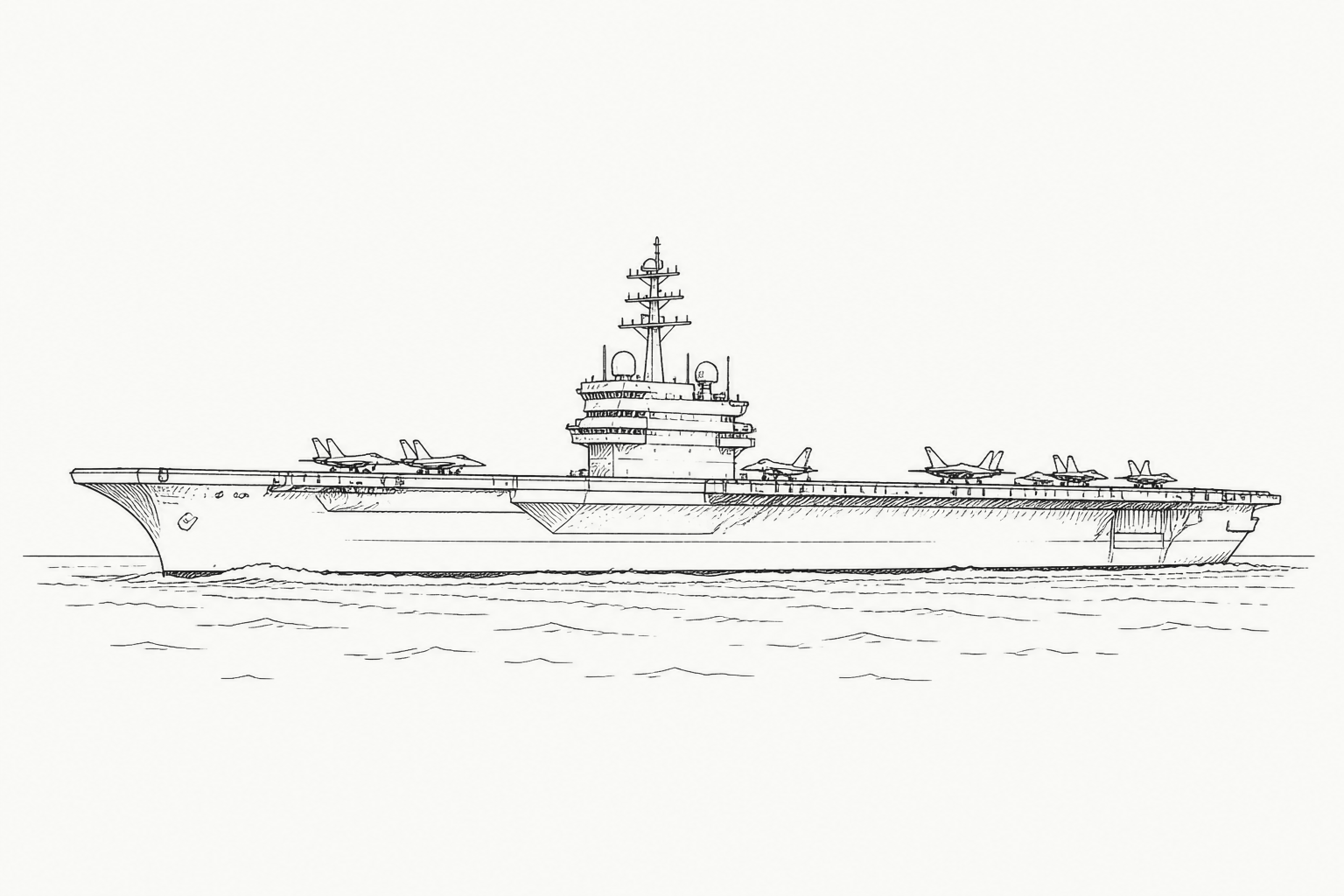
The USS George Washington is departing the western Pacific to replace the USS Abraham Lincoln in the Middle East, leaving the United States without an aircraft carrier in Asia as its open-ended campaign against Iran stretches into a sixth month.
The reshuffle is the sharpest signal yet that the Trump administration's pivot to the Western Hemisphere and its Iran war are pulling the Navy's most visible assets from a region Washington has long called its top strategic priority. Allies in Manila and Tokyo are watching. So is Beijing.
Squeeze on the fleet
The Lincoln has been at sea more than 240 days, a modern record, after its original May return was extended to support strikes on Iran. Democratic lawmakers have called for investigations into conditions aboard, citing mental-health and supply concerns. The USS Gerald R. Ford returned home in mid-May after an 11-month deployment, the longest since the Vietnam War, following a fire in a laundry space that left hundreds of sailors without places to sleep.
The Navy has 11 aircraft carriers and typically deploys two or three at a time, said Bryan Clark, a former Navy submariner at the Hudson Institute. Clark said the service could soon have four under way if the USS Theodore Roosevelt sails from San Diego for the Middle East, freeing the Washington to return west. That surge, he warned, will produce "a maintenance debt that needs to be paid for the next few years" as carriers queue at the country's two shipyards.
Allies and adversaries
Chinese naval forces conducted exercises this week with Indonesia, live-fire drills off Japan's Okinotori island last month, and military operations near the disputed Scarborough Shoal this month. Greg Poling of the Center for Strategic and International Studies said the administration ranks the Pacific second only to the Western Hemisphere but is "doing the exact opposite" of its stated goal of pulling out of the Middle East. Beijing, he added, "is quite happy with U.S. distraction, with the frustration of U.S. allies and partners."
Adm. Frank Bradley, head of U.S. Special Operations Command, was in Manila on Thursday to reassure Filipino counterparts that American special operations forces are ready to expand joint exercises. He is also expected in Japan. Evan Sankey of the Cato Institute said carriers provide "psychological assurance" to allies, and the absence of one in the Pacific "adds to the general sense that the U.S. is distracted by events in the Middle East."
Tehran digs in
The reallocation comes as Iran hardened its position on the Strait of Hormuz. President Trump, speaking Friday at a police academy in Nassau County, N.Y., said he would soon declare the strait a "territory of the United States." Iran's Deputy Foreign Minister Kazem Gharibabadi replied on X early Saturday that the waterway "cannot be seized with a tweet, nor with an aircraft carrier, nor by issuing an order, nor through an election speech."
Only two vessels passed through the strait on Friday, according to ship-tracking firm Kpler, against a peacetime norm of 130 to 140. A bulk carrier was struck by an unknown projectile in the strait Friday, the U.K. Maritime Trade Operations Centre said Saturday; the crew was reported safe. Brent crude futures were on track for a weekly rise of 6 percent, Reuters reported.
The 60-day window Trump and Tehran opened in mid-June closes Monday. Iran's Foreign Minister Abbas Araghchi told Shahrara News there are "no negotiations currently taking place between Tehran and Washington," though Qatar and Pakistan continue to exchange messages as mediators.
The dissent
Not every analyst agrees the Pacific gap matters as much as allies fear. Michael Swaine of the Quincy Institute's East Asia Program said the massive warships are increasingly vulnerable to drones and missiles, and that smaller ships and submarines can strike targets as effectively as carrier-launched jets. Adm. Daryl Caudle, chief of naval operations, told the Associated Press in February that he wants commanders to lean on newer, smaller platforms rather than default to a carrier. Administration officials had not publicly detailed a Pacific replacement schedule by press time.
The next test is the Roosevelt. Clark said its departure from San Diego in the coming weeks will determine how thin the fleet can be stretched before the shipyard bottleneck forces a reckoning.