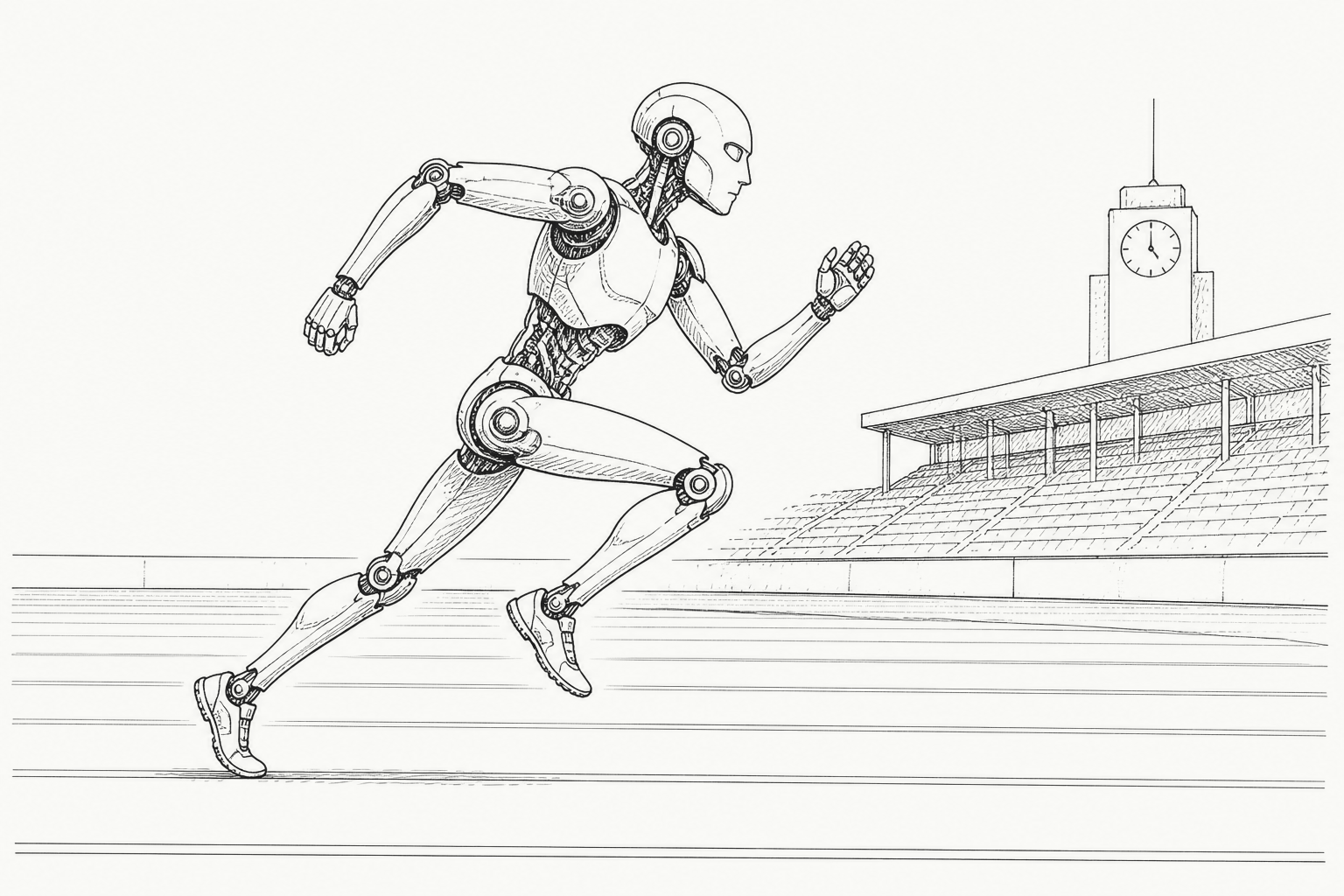
BEIJING — A humanoid robot built by Beijing-based X-Humanoid ran 100 meters in 9.39 seconds at the opening of the World Humanoid Robot Games on Saturday, edging past the 9.58-second mark that Usain Bolt set in 2009 and handing China's fast-moving robotics industry a marquee number to package alongside a blowout Shanghai listing earlier in the week.
The sprint punctuates a stretch in which Chinese humanoid makers have vaulted from novelty to capital-markets story. Shares of rival Unitree Robotics closed 460 percent above their offer price on their Shanghai debut Wednesday, in the first mainland initial public offering by a humanoid maker, while Washington last month barred imports of new foreign-made humanoid robots on national-security grounds. For investors trying to price the AI-capex cycle, an exhibition opening day became a data point on where the manufacturing and the money are going.
The demonstration
A second X-Humanoid model cleared 2.88 meters in the standing high jump, above the 2.45-meter human record that Cuba's Javier Sotomayor set in 1993, CBS News reported. More than 2,000 humanoids are competing in the second year of the games in events that include running, table tennis and soccer. Some entrants tripped, fell and smashed into pieces during competition, and a few caught fire, according to the network. The sprinting robots slowed by slamming into a cushion and collapsing at the finish, before being carried out on stretchers.
The capital-markets read
Unitree, a 10-year-old Hangzhou company that broke through the public consciousness with humanoid martial-arts routines at China's Lunar New Year gala, briefly reached a market value of 445 billion yuan, about $66 billion, in Wednesday's debut on Shanghai's STAR Market. That valuation lands even as the company's founder, Wang Xingxing, has said the technology has not caught up to its price tag. Wang said that "although our robots can now perform some basic assembly tasks, they are still less efficient than humans," in comments carried by NPR.
Rinat Mirzaitov, founder of the tracking firm Humanoid Analytics, told NPR that autonomous performance of household chores was still years out. "Not all tasks that we want, but some basic tasks, I guess, will be implemented autonomously, like bringing tea, bringing coffee, clean up houses," Mirzaitov said.
The Washington backdrop
The U.S. Federal Communications Commission last month banned imports of new foreign-made humanoid robots, citing national security, and the Pentagon added Unitree to its list of companies it says have ties to the Chinese military. Beijing has rejected the designation. American humanoid makers still rely on the Chinese supply chain, NPR's Jennifer Pak reported from Beijing, even as the United States retains an advantage in semiconductors and data.
Naomi Fitter, a robotics professor at Oregon State University, said the contest is not settled by hardware alone. "One thing with robot hardware is it really matters what processing, what kind of common sense and what software architecture is happening under the hood, as far as what the robot can do," Fitter told NPR.
What is not in the picture
Today's coverage of the Beijing spectacle came entirely from U.S. lean-left outlets relaying Chinese demonstrations and analyst commentary. Neither American humanoid-robotics builders nor the FCC, the Pentagon or the White House had publicly responded to Saturday's results in any of the sources at hand, and center-of-the-aisle wire coverage of the sprint had not surfaced by press time. None of the sources described independent race officiating comparable to World Athletics protocols; X-Humanoid supplied the timing.
Running events at the games are scheduled through the week, and Unitree begins its second week as a public company when Shanghai trading resumes Monday.