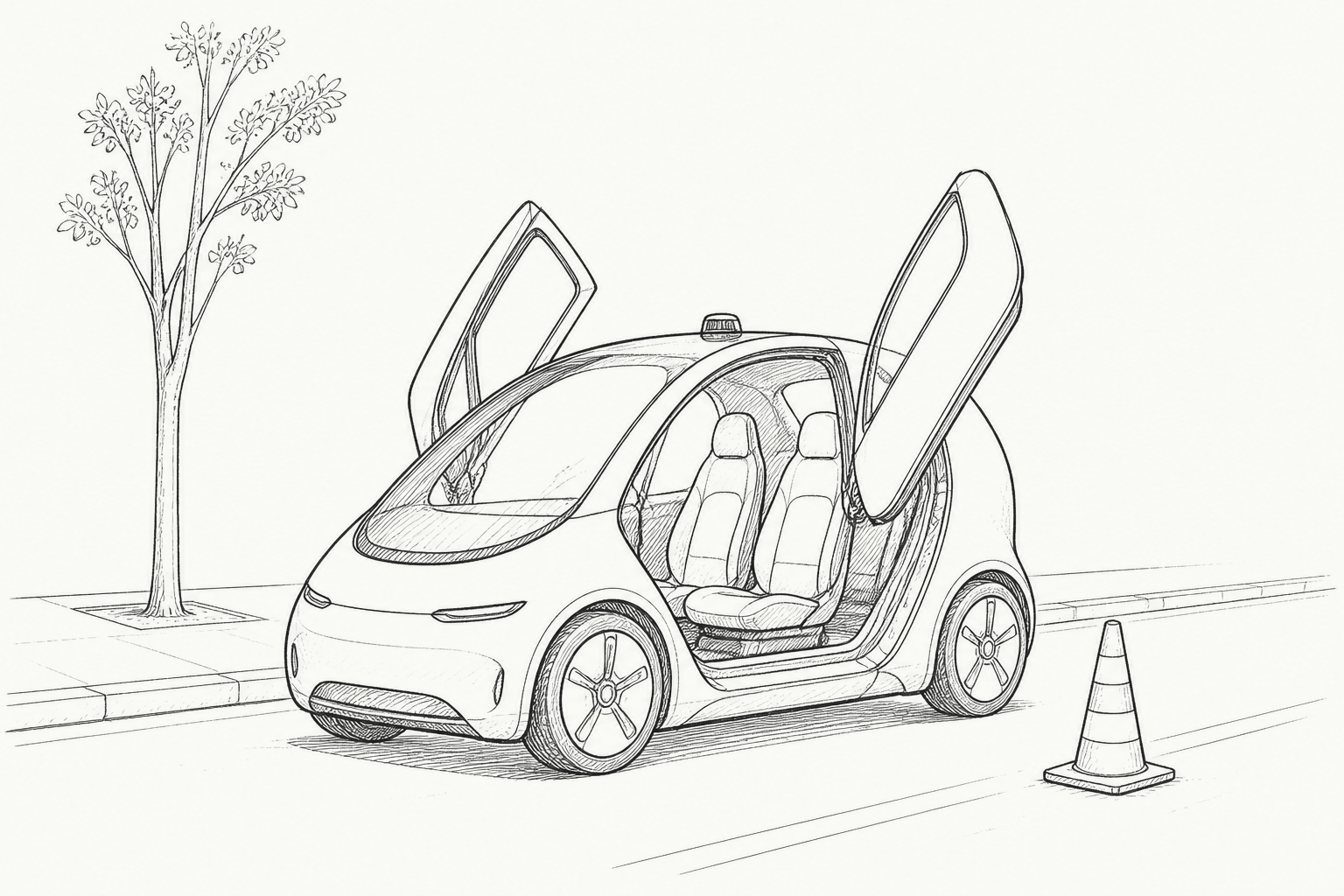
AUSTIN, Texas — Tesla began carrying paying passengers Thursday in its Cybercab, a two-seat driverless coupe with no steering wheel and no brake pedals, and within hours the National Highway Traffic Safety Administration opened an investigation into whether the vehicle complies with federal safety standards.
The Cybercab is the first robotaxi Tesla has designed from scratch to operate without a driver, and its launch on the company's Robotaxi ride-hail network — currently running in a handful of cities in Texas and Florida — is the clearest test yet of Chief Executive Elon Musk's push to have Tesla treated as a robotics and autonomous vehicle company rather than an automaker. The federal probe, filed as an Audit Query, puts that ambition immediately in the hands of a regulator that other driverless-car developers have moved through in orderly fashion.
The certification fight
NHTSA said in its filing that the Cybercab lacks "permanently attached, conventional manual controls, such as a brake pedal, gas pedal, steering wheel, and mirrors." Tesla told the agency it had certified the vehicle as compliant with all applicable Federal Motor Vehicle Safety Standards and planned to expand deployment to additional vehicles and locations. The audit will examine the data and process behind that self-certification.
The agency is separately rewriting eight rules to accommodate driverless cars, including requirements for brake pedals, windshield wipers and rearview mirrors. Until that work is finished, years-old standards remain in force, and vehicles that do not meet them have been directed to seek an exemption. Amazon-owned Zoox, whose robotaxis also lack manual controls, won the first such exemption this summer; it is capped at 2,500 vehicles this year.
Tesla has said publicly that it does not need an exemption because its vehicles already comply. NHTSA Administrator Jonathan Morrison said the agency "fully supports the safe development and deployment of automated vehicles. But as the federal regulator, we need to ensure that all of our laws are followed."
Stakes
Ann Carlson, a former acting NHTSA administrator now teaching environmental law at UCLA, told WIRED the inquiry was likely "an indication that NHTSA is super frustrated with Tesla." She said the agency had established through the Zoox case that driverless developers were expected to seek exemptions. "For Tesla to slap them in the face and ignore that—that is gobsmacking," she said.
Audit queries have carried real costs. Volvo Group North America paid $130 million in penalties in 2023 after a NHTSA recall-process investigation and accepted three years of third-party oversight.
The counterpoint
The Washington Examiner framed the launch around Musk's presentation of the Cybercab as "the future of transportation" and noted that Tesla's camera-only approach to autonomy diverges from the lidar-radar-camera stacks used by Waymo and Zoox. Tesla has argued its Full Self-Driving software, already deployed on Cybertrucks, needs no exemption because the underlying vehicle meets the standards as written.
Texas records show 45 Cybercabs in Tesla's state fleet. The company has said it intends to deploy the vehicle at a rate of millions per year.